What traffic control equipment does a roadwork site need?
There is no single equipment list that suits every roadwork or construction site. A short shoulder closure on a low-speed street may need a very different setup from night works on a regional highway, a staged civil project, or a lane closure beside heavy traffic. The right traffic control equipment should follow the approved traffic arrangement for the job, including the relevant Traffic Management Plan or Traffic Guidance Scheme where one is required.
That distinction matters because traffic equipment is not simply a collection of signs and trailers placed around a work area. Each device has a specific job, such as warning drivers, directing them around a work zone, controlling alternating traffic, improving visibility, or communicating changing conditions. Using more equipment does not automatically create a better setup if the devices are unnecessary, poorly positioned, or conflict with each other.
This guide explains the main types of traffic management equipment used around South Australian roadworks and construction sites, what each item is designed to do, and the factors that determine which equipment a project may need.
Start with the traffic plan, not the equipment list
The first step is to understand how traffic needs to move around the work. The road environment, construction activity, work-zone position, posted speed, traffic volume, pedestrian movements, duration, time of day, and available road width can all influence the traffic-control arrangement.
In South Australia, temporary traffic management should follow the Austroads Guide to Temporary Traffic Management together with the relevant South Australian requirements. The current DIT framework also requires traffic control devices used on or near roads to align with the applicable standards, approvals, and traffic guidance arrangements.
A project should therefore avoid choosing equipment first and trying to build the traffic setup around it. The better sequence is to identify the traffic risks, determine the required arrangement, prepare or obtain the necessary traffic documentation, and then select the devices required to implement that arrangement.
Smooth Flow provides traffic management plans and traffic guidance schemes for roadworks, civil projects, intersections, detours, and other temporary traffic situations across South Australia.
1. Temporary traffic signs provide the basic instructions and warnings
Temporary traffic signs are one of the foundations of most roadwork traffic setups. They can warn road users that works are ahead, communicate temporary speed restrictions, indicate changed road conditions, direct traffic through a detour, identify lane changes, or provide other approved instructions.
The exact signs required depend on the approved traffic arrangement. Signs also need to be placed at suitable distances so drivers have enough time to see, understand, and respond to them. On higher-speed roads, this may require warning to begin significantly further from the work area than it would on a low-speed urban street.
Existing permanent signs also need to be considered. DIT's July 2026 temporary traffic management update specifically highlighted problems caused by permanent speed signs conflicting with temporary worksite speed restrictions. Where an existing sign conflicts with the approved temporary arrangement, the relevant requirements may call for it to be covered, removed from view, or otherwise managed for the duration of the works.
For specialised applications, custom traffic signs may also be useful, provided any sign being used as a traffic control device is appropriate for the approved arrangement and relevant requirements.
2. Cones, bollards and barriers help define the work zone
Delineation devices help road users understand where they should and should not travel. Cones, bollards, barriers, and similar devices can separate traffic from a work area, guide vehicles through a changed alignment, protect pedestrian routes, or make a lane taper easier to identify.
The appropriate device depends on the risk being controlled. A line of cones can visually define a low-risk temporary boundary, but it should not be treated as providing the same physical protection as an approved road safety barrier system. Where workers, excavations, plant, or other hazards are close to live traffic, the traffic-management design needs to consider the level of separation or protection actually required.
Spacing and placement are also important. Poorly positioned delineation can create an unclear path, narrow the available lane unexpectedly, or encourage drivers to enter the work area too early. The layout should be installed in accordance with the approved TGS rather than adjusted casually to suit the equipment available on the day.
3. Portable traffic lights can control alternating traffic
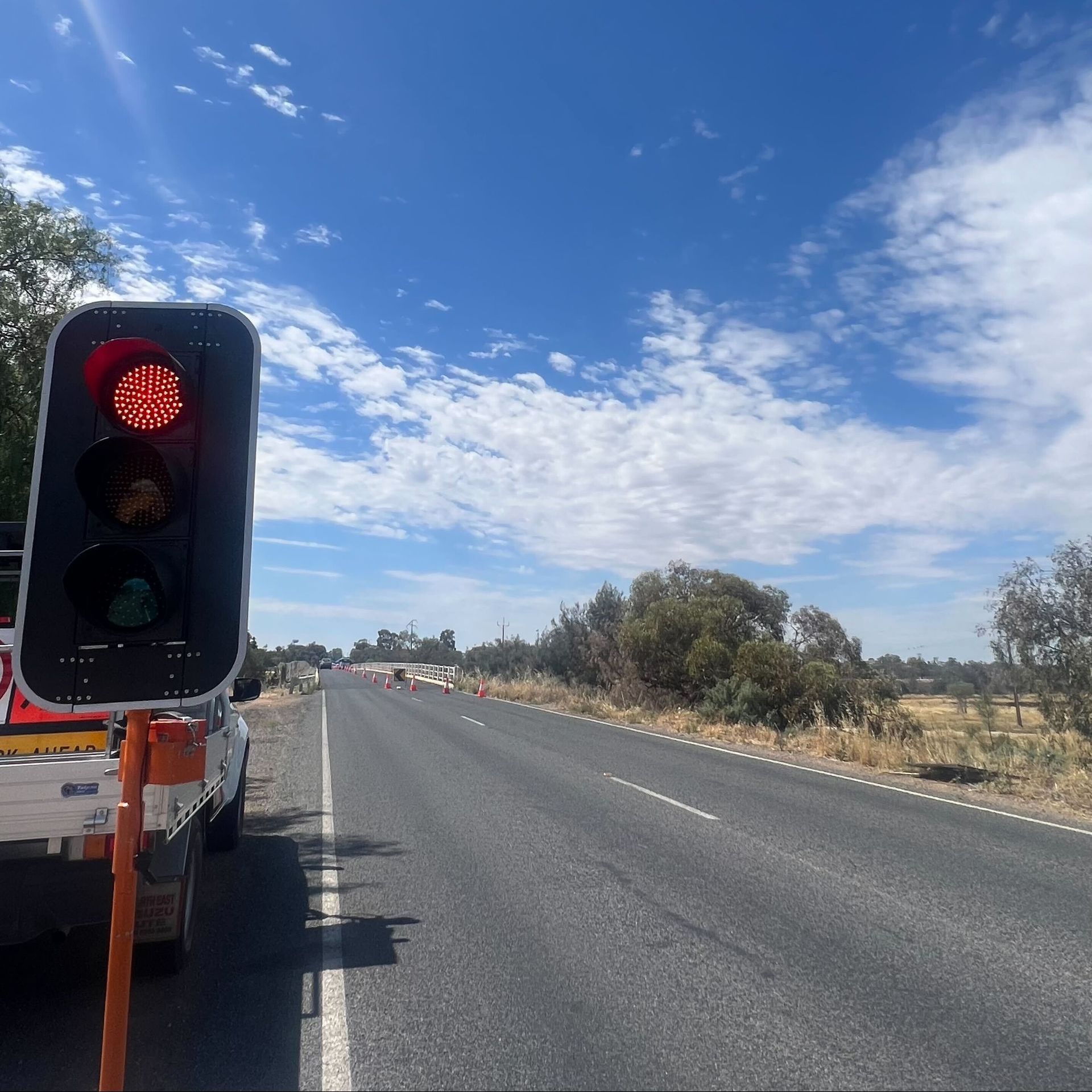
Portable traffic lights can be used where traffic needs to alternate through a single usable lane or controlled section of road. They are particularly useful where a lane is closed and vehicles from opposing directions cannot safely pass the work area at the same time.
Portable signals can reduce the need for traffic controllers to stand continuously at each control point in suitable situations, but they still need to be selected, positioned, and operated as part of the approved traffic arrangement. Factors such as the length of the controlled section, traffic volumes, visibility between approaches, side roads, pedestrian movements, and expected queues can all affect whether portable signals are appropriate.
They should not be selected simply because a project has a lane closure. Some sites may be better suited to traffic controllers, while others may require a more robust trailer-mounted arrangement or different control method.
4. Trailer-mounted traffic lights can suit longer or more demanding setups
Trailer-mounted traffic lights perform a similar basic traffic-control function but can be suited to projects where a larger, more substantial temporary signal setup is required. Their trailer configuration can make them practical for staged roadworks, longer-duration works, or sites where equipment needs to remain in position for an extended period.
The distinction between portable and trailer-mounted signals is not simply a question of which unit is larger. The site conditions, operating requirements, available shoulder space, duration, visibility, transport requirements, and approved traffic plan should determine the most suitable option.
Blog 10 in this series will look specifically at portable versus trailer-mounted traffic lights and when each option may make sense. For the purposes of an overall equipment plan, the important point is that traffic signals should be selected around the required traffic operation, not treated as interchangeable hardware.
5. VMS boards communicate changing information before drivers reach the site
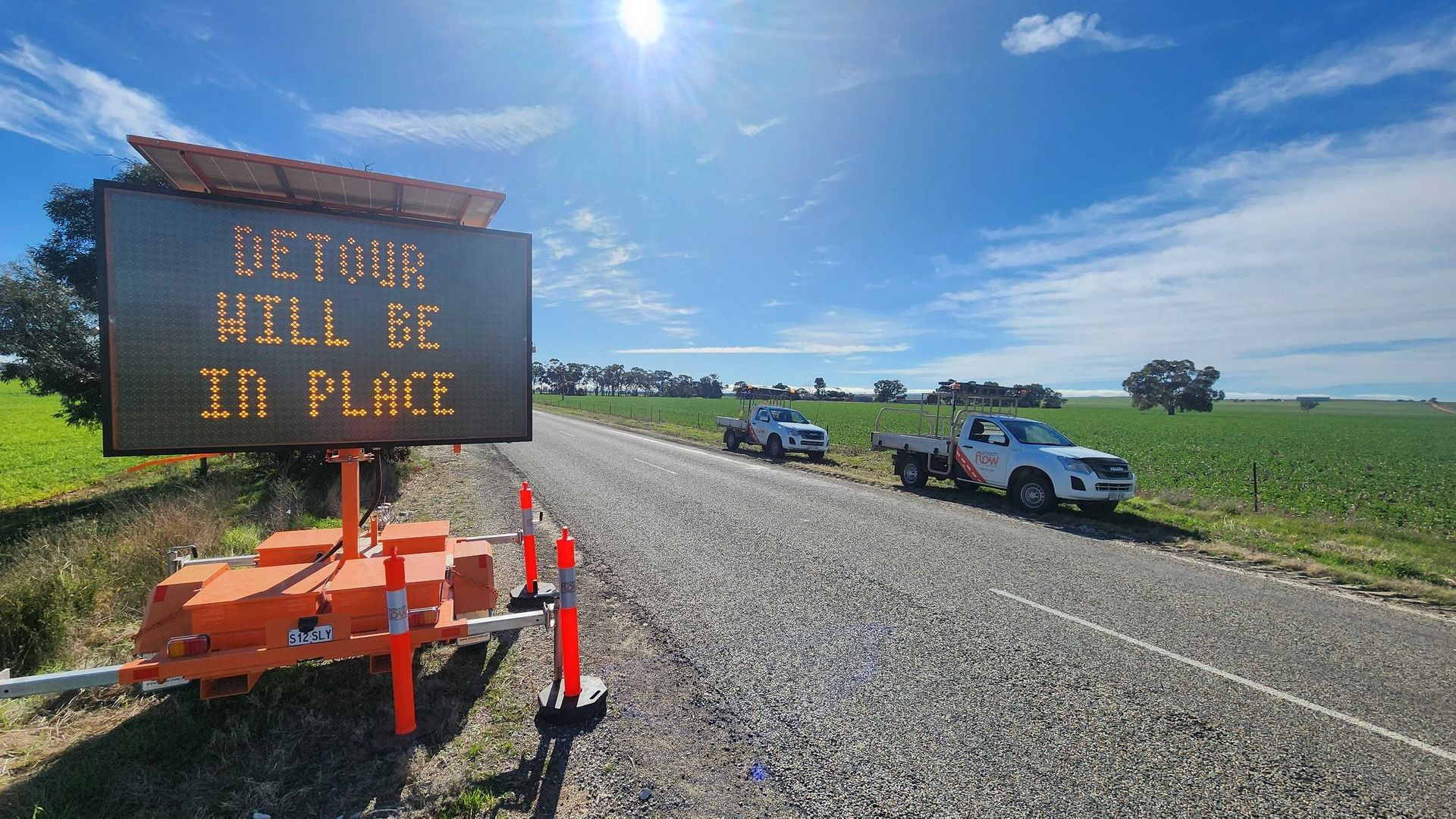
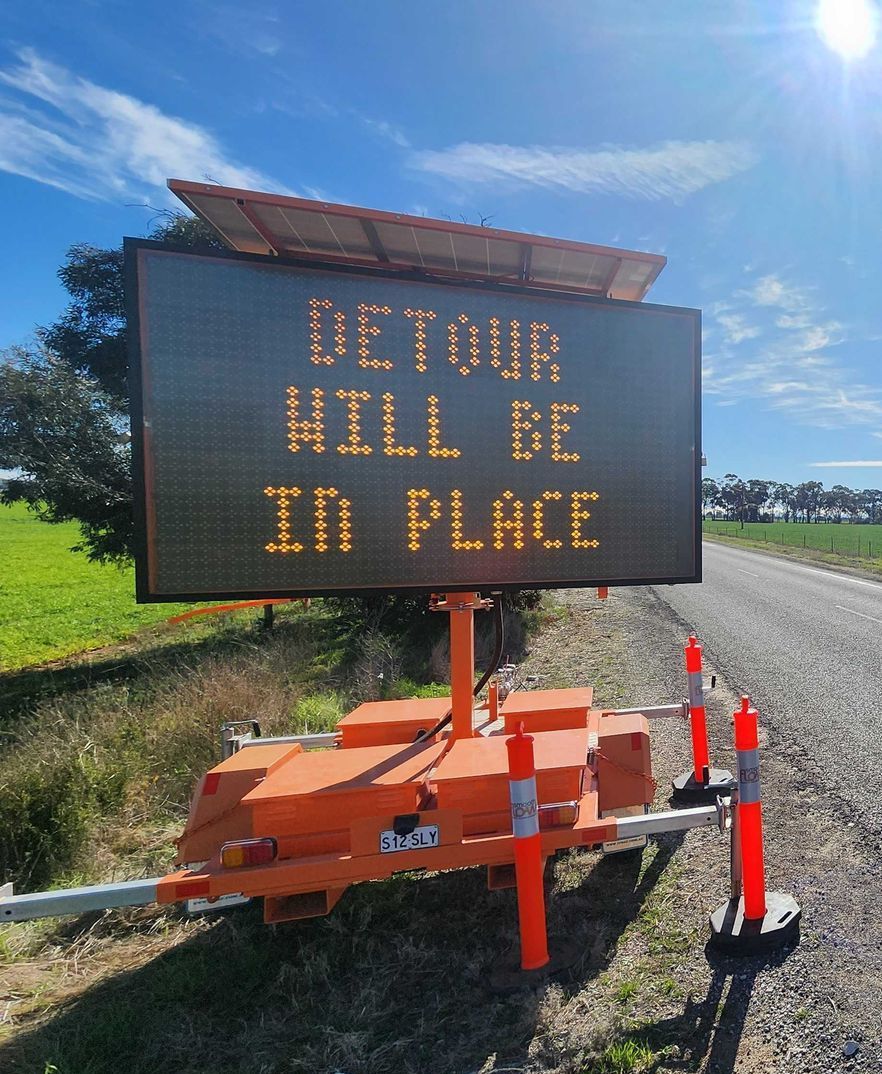
Variable Message Sign boards, commonly called VMS boards, can provide advance notice of roadworks, changed conditions, closures, detours, delays, or other temporary information. They are especially useful where drivers need information before they reach the immediate traffic-control zone.
DIT advises that VMS boards may be required for larger-scale works with significant traffic impacts or works that continue for longer periods. Importantly, the South Australian standards state that portable VMS should supplement conventional roadside signs and markings rather than replace them.
That makes VMS most useful as part of a wider traffic-management system. A board several kilometres before a closure may warn drivers to choose another route, while conventional signs closer to the work zone provide the detailed regulatory and directional information required to move safely through the area.
Messages also need to be concise and approved where required. The objective is to give drivers enough information to make a decision without creating a display that takes too long to read at road speed.
6. Arrow boards help direct traffic around lane changes and mobile works
Trailer-mounted arrow boards provide a highly visible directional warning where traffic needs to move away from a lane, vehicle, or work area. They can be useful for lane closures, mobile works, maintenance activities, and other situations where approaching drivers need a clear visual indication of the required direction of travel.
Arrow boards are particularly valuable where the traffic environment is busy or where a standard static sign may not provide enough visual emphasis on its own. However, they still need to form part of a coordinated setup. A flashing arrow should reinforce the lane arrangement established by the traffic guidance scheme rather than introduce a direction that conflicts with nearby signs, cones, or lane markings.
The equipment also needs to remain visible under the actual site conditions. Curves, crests, parked plant, road geometry, glare, darkness, and queues can all affect how early approaching drivers can see a directional device.
7. Lighting towers support night works and low-light traffic control
Night work introduces different visibility risks for road users, traffic controllers, and construction crews. Intersections, traffic-controller positions, areas where workers or plant may approach live lanes, and other critical parts of the site may require additional illumination.
Lighting tower hire can support night roadworks, remote projects, emergency works, and other low-light operations. The aim is not simply to make the worksite as bright as possible. Lighting needs to illuminate the areas that matter without creating excessive glare that makes signs, signals, workers, or the road alignment harder for approaching drivers to see.
Positioning therefore matters. Lighting towers should be incorporated into the worksite arrangement with consideration for vehicle approaches, traffic-control points, plant movement, and the direction of the light.
8. Traffic-control vehicles and warning devices may be required for mobile or exposed work
Some traffic-management activities rely on vehicles as part of the control setup. Traffic-control utes, pilot vehicles, shadow vehicles, vehicle-mounted warning devices, and other specialist vehicles can support mobile works, inspections, lane closures, oversize movements, and work that changes position along a road corridor.
The equipment fitted to a vehicle needs to suit its purpose. Warning beacons, illuminated directional devices, mounted signs, or other traffic-control equipment may be used to make the vehicle visible and communicate the intended traffic movement.
For certain higher-risk applications, additional protection such as a truck-mounted attenuator may also be specified. DIT describes a TMA as a last line of defence for workers and sets specific requirements for their use in live trafficked lanes. Not every roadwork site needs one, so the need should come from the risk assessment and approved traffic arrangement.
9. Pedestrian management equipment may be just as important as vehicle equipment
Construction and roadworks can affect footpaths, crossings, shared paths, public transport stops, property access, and other pedestrian routes. The equipment plan therefore needs to consider people on foot rather than focusing only on vehicle traffic.
Depending on the site, pedestrian management may involve barriers, temporary fencing, signs, controlled crossing points, temporary paths, lighting, or traffic controllers. The route should be clear, practical, and accessible, and it should avoid directing pedestrians into plant operating areas or vehicle entry points.
This is especially important on urban civil projects where a footpath closure can push pedestrians towards a live lane or construction access point if the alternative route has not been planned properly.
10. The equipment can change as the project moves through different stages
A long construction project rarely uses exactly the same traffic setup from beginning to end. Excavation may require one lane arrangement, service installation another, concrete works another, and final resurfacing or reinstatement another again.
Each change in the work area can affect the equipment required. Portable signals may only be needed for one stage. A VMS board may be useful before a major closure but unnecessary during lower-impact works. Lighting towers may only be required for night shifts, while arrow boards may become important when works transition from a static site to a moving operation.
Planning these changes early helps the project team arrange the correct equipment, delivery dates, traffic controllers, and revised TGS drawings before each stage begins. It also avoids leaving unnecessary signs or devices in place after the risk they were controlling has disappeared.
What determines the traffic equipment a site needs?
The equipment selection should be based on the project rather than a standard package. Factors commonly considered include:
- road type and road authority
- posted and temporary speed environment
- traffic volume and peak periods
- number and width of available lanes
- work-zone location and clearance from traffic
- lane, shoulder, footpath, or road closures
- construction staging and duration
- expected traffic queues
- pedestrian and cyclist movements
- night work or poor visibility
- intersections and side-road access
- heavy vehicles and construction plant
- remote or regional site conditions
- the requirements of the approved TMP or TGS
Because these factors interact, two roadworks carrying out the same construction activity can still need very different equipment.
Traffic control equipment checklist for project planning
Before arranging equipment hire, project teams should be able to confirm:
- what traffic movement needs to be maintained
- which areas of the road or footpath will be occupied
- whether a TMP or TGS has been prepared and approved where required
- which conventional signs and delineation devices are specified
- whether alternating traffic needs controllers or temporary signals
- whether VMS boards are needed for advance warning or route information
- whether arrow boards are required for directional warning
- whether night work needs additional lighting
- how pedestrians and cyclists will move around the site
- which equipment needs to remain in place overnight
- how the equipment requirements change between construction stages
- who is responsible for installing, checking, adjusting, and removing the traffic controls
Frequently asked questions about traffic control equipment
Does every roadwork site need the same traffic equipment?
No. Equipment should be selected to suit the traffic risks, road environment, work activity, project stage, and approved traffic-control arrangement. A small urban job can require a very different setup from a highway lane closure or remote civil project.
Does a VMS board replace normal roadwork signs?
No. DIT's current South Australian standards state that portable VMS boards should supplement existing roadside infrastructure and should not be used as a substitute for conventional signs and pavement markings.
When are portable traffic lights useful?
They can be useful where opposing traffic needs to alternate through a single lane or controlled section of road. Suitability depends on factors such as traffic demand, controlled-section length, visibility, side roads, pedestrian movements, and the approved traffic arrangement.
Are lighting towers only needed on remote sites?
No. Lighting towers can support any night or low-light work where additional illumination is required, including urban roadworks, civil sites, emergency works, intersections, and remote projects.
Can traffic equipment be hired without traffic controllers?
Some equipment can be hired as standalone equipment, but the project still needs appropriately qualified personnel and an approved arrangement where required to install, operate, inspect, adjust, or remove traffic-control devices. The correct delivery model depends on the project and equipment.
Match the traffic equipment to the work, not the other way around
Good traffic management comes from combining the correct traffic plan, people, and equipment. Signs, portable traffic lights, VMS boards, arrow boards, lighting towers, barriers, and traffic-control vehicles all solve different problems, and a project may need some, all, or very few of them depending on the road environment and work being carried out.
Smooth Flow Traffic Management supplies traffic management equipment for hire across Adelaide, regional South Australia, and remote project locations, alongside traffic control services and traffic planning. Explore the equipment range to compare available options for your project.
If you have a worksite location, construction program, or traffic plan ready, contact our team to discuss the traffic control equipment required for your project.
External guidance: South Australian temporary traffic management documents and DIT Roadworks Portal FAQs.