What should a construction traffic management plan include?
A construction traffic management plan should do more than show where a few signs or cones will be placed. It should explain how vehicles, plant, workers, pedestrians, cyclists, deliveries, and public traffic will be managed throughout the construction works. For projects in South Australia, the plan also needs to reflect the road environment, relevant authority requirements, and the temporary traffic management standards that apply to the work.
The exact content will vary from project to project. A small site with one access point will not need the same level of detail as staged civil works affecting a busy arterial road, multiple intersections, pedestrian routes, and heavy vehicle movements. However, there are several core areas that a well-prepared construction traffic management plan should address.
This guide explains the main inclusions to consider, how a construction traffic management plan connects with traffic guidance schemes, and what project teams should have ready before planning begins.
What is a construction traffic management plan?
A construction traffic management plan, often shortened to CTMP or TMP, sets out how traffic-related risks and movements will be managed during construction. It considers both the activity inside the site and the effect construction can have on the surrounding road and pedestrian network.
Safe Work Australia identifies traffic management as an important part of managing construction risks. Construction workplaces can involve cars, trucks, powered mobile plant, workers, visitors, and pedestrians using the same or nearby areas. The plan should therefore consider how these movements can be separated, controlled, and monitored.
For work on or near a public road, the relevant road authority requirements also need to be considered. In South Australia, temporary traffic management should follow the Austroads Guide to Temporary Traffic Management along with the South Australian Standards for Workzone Traffic Management and the state's Supplement to AS 1742.3.
Smooth Flow provides traffic control plans and traffic management planning for construction, civil, roadwork, mining, and other projects across South Australia.
What should a construction traffic management plan include?
The plan should be proportionate to the scale and risk of the work, but the following areas are commonly important for construction projects.
Project scope and construction stages
The plan should start by clearly describing the works being undertaken and how the construction program will progress. Traffic arrangements often change as a project moves from early works and site establishment through excavation, structural works, services, finishing, and demobilisation.
Where traffic impacts change between stages, the plan should identify those changes rather than assume one arrangement will remain suitable for the entire project. This can include changes to access points, work zones, lane closures, pedestrian routes, delivery areas, or temporary traffic controls.
A staged approach is especially important on longer civil and infrastructure projects where construction moves along a road corridor or where different sections of the site become active at different times.
Site entry and exit points
Construction access should be planned so vehicles can enter and leave the site with as little conflict as reasonably practicable. The plan should identify the location of each access point and consider visibility, traffic speeds, nearby intersections, driveways, pedestrian activity, and the types of vehicles using the entrance.
Large trucks and plant may need more room to turn than passenger vehicles. If a vehicle cannot enter the site without crossing several lanes, reversing into traffic, or blocking a footpath, additional controls may be required.
The plan should also consider how mud, debris, queuing, and parked vehicles around the access point will be managed so they do not create additional hazards or disrupt normal traffic.
Vehicle routes and construction movements
A construction traffic management plan should identify how vehicles will move through the site and, where relevant, the surrounding road network. This may include nominated haulage routes, delivery routes, entry and exit directions, internal travel paths, turning areas, and locations where vehicles can wait safely.
Vehicle movements should be considered alongside the construction program. Concrete deliveries, spoil removal, cranes, floats, oversize vehicles, and regular material deliveries can create very different traffic demands.
Where practical, movements should be organised to reduce conflicts between vehicles, workers, and members of the public. The plan may also identify times when certain movements should occur to avoid peak traffic or busy pedestrian periods.
Heavy vehicles, plant, and reversing risks
Construction sites regularly use trucks, excavators, loaders, cranes, forklifts, and other powered mobile plant. These vehicles can have large blind spots, limited manoeuvrability, and different stopping distances from ordinary road vehicles.
The plan should consider how heavy vehicles will turn, load, unload, park, and reverse. Safe Work Australia recommends separating pedestrians and vehicles where possible, minimising unnecessary vehicle movements, and eliminating reversing where reasonably practicable or otherwise reducing the associated risk.
Where heavy vehicles need to enter from or cross a live road, the plan should also consider how the movement will interact with public traffic and whether traffic controllers or temporary traffic controls are required.
Pedestrian and cyclist management
Pedestrians and cyclists should not be treated as an afterthought. A construction project can temporarily block or alter footpaths, shared paths, crossings, cycle routes, property access, and routes used by workers or visitors.
The plan may need to identify temporary pedestrian paths, protected walkways, exclusion zones, alternate crossings, barriers, accessible routes, and points where people could interact with site vehicles.
Special attention may be needed around schools, shops, public transport stops, community facilities, residential areas, or other locations where pedestrian activity is high. The aim should be to maintain clear, practical routes while separating people from construction traffic as far as reasonably practicable.
Loading, unloading, and delivery areas
Loading and unloading can create concentrated periods of vehicle and pedestrian interaction. The construction traffic management plan should identify where these activities will occur and how vehicles will access the area without creating unnecessary conflicts.
Where on-site space is limited, the plan may need to address delivery scheduling, vehicle holding areas, spotters, traffic controllers, loading zones, or restrictions on when deliveries can arrive.
Project teams should also consider what happens if several vehicles arrive at once. Queuing onto a live road, footpath, or neighbouring property can create safety and access problems that should be addressed before work begins.
Road, lane, and footpath closures
If construction requires a lane closure, road closure, shoulder occupation, footpath closure, or other temporary change to the public road environment, the plan should describe how the impact will be managed.
This can include detour routes, temporary lane arrangements, changes to parking, pedestrian diversions, access for local properties, and measures to maintain emergency or public transport access.
For works affecting roads under the control of South Australia's Department for Infrastructure and Transport, project teams should confirm the relevant Roadworks Portal and permit requirements before mobilisation.
Traffic guidance schemes and temporary traffic control devices
A construction traffic management plan provides the broader strategy, but individual work areas may also need one or more traffic guidance schemes, commonly referred to as TGSs. A TGS shows the site-specific layout of temporary traffic control devices used to guide road users through or around the work area.
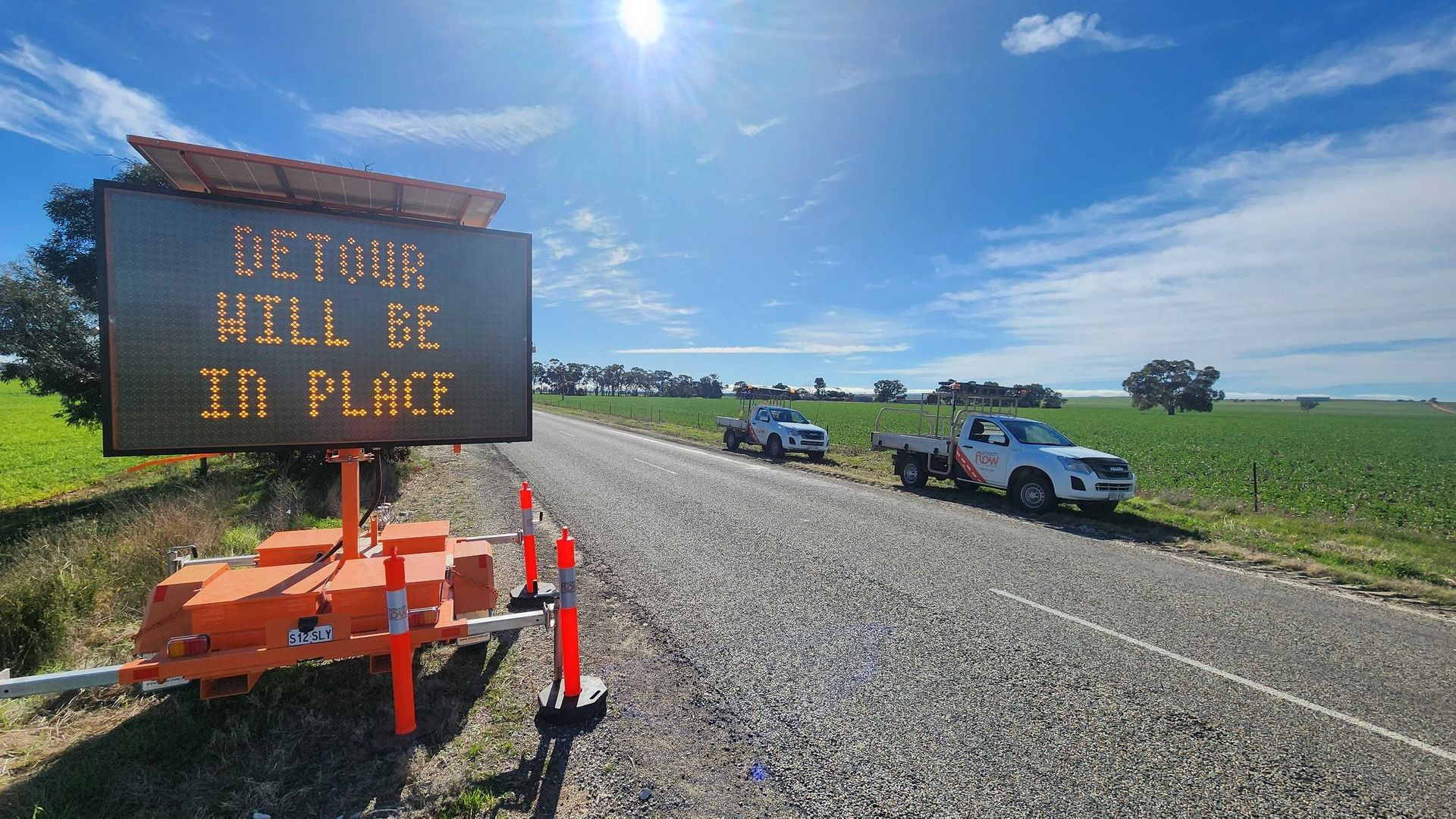
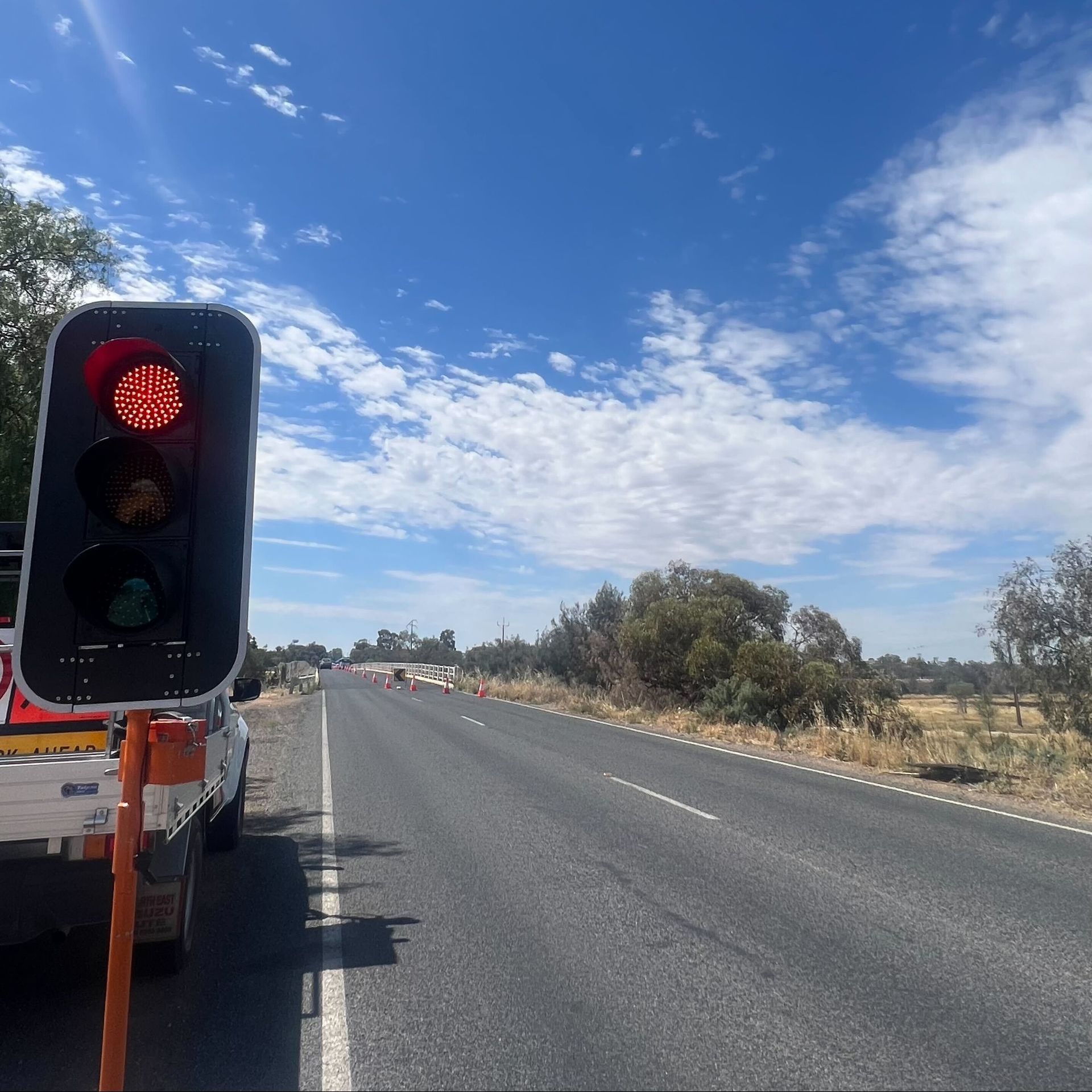
Depending on the work, a TGS may show signs, cones, barriers, traffic controller positions, lane tapers, temporary signals, arrow boards, variable message signs, pedestrian controls, and work-zone boundaries.
Complex projects can require different TGS drawings for separate construction stages or work areas. The traffic arrangements shown on each scheme should match the actual road conditions and the work being performed.
Once the arrangements are approved, Smooth Flow's traffic control services can support their practical implementation through traffic controllers, road and lane closures, detours, stop and slow operations, and other project-specific controls.
Signs, barriers, and traffic management equipment
The plan should identify the types of temporary controls that may be required to support the works. This can include regulatory and warning signs, cones, barriers, lighting, portable traffic signals, arrow boards, and variable message signs.
The exact equipment should be based on the approved traffic arrangement rather than selected independently. Road speed, traffic volume, work duration, visibility, lane configuration, night work, and site complexity can all influence what is required.
Where additional equipment is needed, Smooth Flow also provides traffic control equipment hire for urban, regional, and remote projects throughout South Australia.
Parking and worker access
Construction worker and visitor parking can have a noticeable impact on surrounding streets, particularly on longer projects or sites with limited internal parking. The plan should consider where workers will park and how they will travel between parking areas and the site.
Parking arrangements should avoid creating visibility problems, blocking neighbouring access, or concentrating pedestrian movements in unsafe locations. Where the workforce changes significantly between construction stages, parking demand may also need to be reviewed.
Emergency access and incident arrangements
The construction traffic management plan should account for emergency access. Traffic controls, barriers, parked vehicles, work zones, and construction plant should not prevent emergency services from reaching the site or nearby properties when access must be maintained.
The plan may also outline how traffic arrangements will be managed if there is an incident, unexpected road closure, equipment failure, or other condition that makes the normal setup unsuitable.
For larger projects, emergency procedures should align with the wider project safety and incident-management arrangements.
Roles and responsibilities
A plan is more useful when it clearly identifies who is responsible for implementing, supervising, reviewing, and changing traffic arrangements. This can include project managers, site supervisors, traffic management personnel, traffic controllers, drivers, subcontractors, and workers who interact with traffic.
Responsibilities should be communicated before work begins so people understand who can authorise changes, who monitors the site, and how traffic issues are reported and addressed.
Monitoring and review
Traffic management should not stop once the plan has been written. Conditions on a construction project change, and an arrangement that worked at one stage may no longer be suitable later.
The plan should explain how traffic arrangements will be monitored and when they should be reviewed. Reasons for review can include changed construction stages, unexpected queuing, restricted sight distance, increased pedestrian activity, incidents, complaints, changes to access, or revised road authority requirements.
Current DIT guidance also reflects the broader Austroads approach, which places emphasis on checking and reviewing temporary traffic management practices rather than treating the original plan as a static document.
What South Australian requirements should be considered?
Temporary traffic management in South Australia now uses the Austroads Guide to Temporary Traffic Management as the primary national reference. DIT's South Australian documents complement that guide with state-specific requirements, including the South Australian Standards for Workzone Traffic Management and Supplement to AS 1742.3.
DIT advises that temporary traffic management workers must ensure their work complies with the relevant Austroads guide parts, South Australian standards, technical requirements, AS 1742.3, and the South Australian Road Traffic Act and Regulations.
Requirements can also differ depending on whether the affected road is controlled by DIT, a local council, or another asset owner. The project team should therefore confirm the responsible authority and approval process early.
Learn more about our civil traffic management services for construction and civil works across South Australia.
What information is needed before preparing the plan?
The quality of the final plan depends heavily on the project information available at the start. Providing a clear scope helps the traffic planner understand how construction will interact with the site and surrounding road network.
Useful information can include:
- the worksite address and affected roads
- site plans and construction drawings
- the construction program and major stages
- proposed work hours
- site entry and exit locations
- expected delivery and heavy vehicle types
- loading and unloading requirements
- known lane, footpath, or road closures
- plant and machinery movements
- worker and visitor parking arrangements
- pedestrian and cyclist impacts
- nearby public transport, schools, businesses, or community facilities
- known council, DIT, permit, or development-approval conditions
Providing these details before the plan is developed can reduce avoidable revisions and make it easier to coordinate the traffic arrangements with the actual construction methodology.
Frequently asked questions about construction traffic management plans
Is a construction traffic management plan the same as a TGS?
No. A construction traffic management plan describes the broader strategy for managing traffic risks and movements throughout the project. A traffic guidance scheme shows the site-specific layout of temporary traffic control devices for a particular work area or stage. A larger project may use one overarching plan supported by several TGS drawings.
Does a CTMP only cover traffic outside the construction site?
No. Construction traffic management can include both internal and external movements. The plan may cover plant, trucks, pedestrians, loading areas, parking, and internal travel paths as well as the effect of the work on public roads, footpaths, cyclists, and nearby properties.
Does the plan need to cover pedestrians?
Yes, where pedestrians could be affected. Safe Work Australia specifically identifies the flow and interaction of pedestrians and vehicles as an important consideration in traffic management planning. Temporary pedestrian routes, barriers, crossings, and separation from vehicles may need to be addressed.
Does a construction traffic management plan need to be updated?
It may need to be reviewed or revised if the construction methodology, work stage, access points, traffic conditions, road authority requirements, or approved traffic controls change. Monitoring the site helps confirm that the documented arrangements remain appropriate for actual conditions.
Plan construction traffic management before mobilisation
A useful construction traffic management plan connects the construction methodology with the real traffic environment around the site. It should identify how vehicles, plant, workers, pedestrians, cyclists, deliveries, closures, temporary controls, and project stages will be managed, while allowing for monitoring and changes as the job progresses.
Smooth Flow Traffic Management supports civil and construction projects across Adelaide, regional South Australia, and remote areas with traffic planning, traffic control, and traffic management equipment.
If you have a construction program, site plan, or upcoming work package ready, contact our team to discuss your traffic management requirements and the planning needed before mobilisation.
External guidance: South Australian traffic management documents and Safe Work Australia traffic management guidance.